

The Voyage Of James Caird
| Sir James Clark Ross DCL FRS FLS FRAS | |
|---|---|
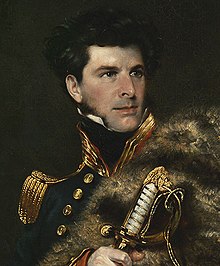 1834 painting of James Clark Ross | |
| Birth proper name | James Clark Ross |
| Built-in | (1800-04-fifteen)15 April 1800 Finsbury Square, London, England |
| Died | three Apr 1862(1862-04-03) (aged 61) Aston Abbotts, Buckinghamshire, England |
| Buried | St James the Great, Aston Abbotts |
| Branch |  Imperial Navy Imperial Navy |
| Service years | 1812–1862 |
| Rank | Rear-Admiral of the Red |
| Expeditions | Ross expedition (1839–1843) |
| Awards |
|
| Spouse(s) | Ann Coulman (m. 1843; died 1857) |
| Relations | Sir John Ross (uncle) |
Sir James Clark Ross DCL FRS FLS FRAS (15 Apr 1800 – three Apr 1862) was a British Regal Navy officer and polar explorer known for his explorations of the Arctic, participating in two expeditions led past his uncle John Ross, and four led by William Edward Parry, and, in particular, for his ain Antarctic expedition from 1839 to 1843.
Biography [edit]
Early life [edit]
Ross was built-in in London, the son of George Ross[ane] and nephew of John Ross, under whom he entered the Royal Navy on 5 April 1812.[1] [ii] Ross was an active participant in the Napoleonic Wars, existence present at an action where HMS Briseis, commanded past his uncle, captured Le Petit Poucet (a French privateer) on nine Oct 1812.[3] Ross then served successively with his uncle on HMS Actaeon and HMS Driver.[1]
Arctic exploration [edit]

Ross participated in John'southward unsuccessful first Arctic voyage in search of a Northwest Passage in 1818 aboard Isabella.[2] Betwixt 1819 and 1827 Ross took function in four Chill expeditions under William Edward Parry, taking particular interest in magnetism and natural history.[2] This was also where he served as midshipman with Francis Crozier, who would afterward go his close friend and 2d-in-command. From 1829 to 1833 Ross again served nether his uncle on John'southward 2d Chill voyage. It was during this trip that a minor party led by James Ross (including Thomas Abernethy) located the position of the northward magnetic pole on 1 June 1831, on the Boothia Peninsula in the far northward of Canada, and James Ross personally planted the British flag at the pole.[1] It was on this trip, also, that Ross charted the Beaufort Islands, later renamed Clarence Islands by his uncle.[4] [5] Ross and so served as supernumerary-commander of HMS Victory in Portsmouth for 12 months.[1]
On 28 October 1834[ane] Ross was promoted to captain. In Dec 1835 he offered his services to the Admiralty to resupply 11 whaling ships which had become trapped in Baffin Bay. They accustomed his offer, and he prepare canvass in HMS Cove in January 1836. The crossing was difficult, and by the time he had reached the last known position of the whalers in June, all only 1 had managed to return dwelling house. Ross found no trace of this last vessel, William Torr, which was probably crushed in the ice in December 1835.[half dozen] He returned to Hull in September 1836 with all his crew in good health.
British Magnetic Survey [edit]
From 1835 to 1839, except for his voyage with Cove, he was one of the principal participants in the British Magnetic Survey, a magnetic survey of Great Uk, with Edward Sabine, John Phillips and Humphrey Lloyd. This also included some piece of work on geomagnetic measurements in Ireland in 1834–1835, working with Sabine and Lloyd. In 1837, Ross assisted in T. C. Robinson's comeback of the dip circle during the survey; anomalous results had been discovered by Ross in 1835 in Westbourne Light-green. In 1838, Ross completed magnetic observations at 12 different stations throughout Republic of ireland. The survey was completed in 1938; some supplementary measurements by Robert Were Fox were too used.[7]
Antarctic exploration [edit]

On 8 Apr 1839, Ross was given orders to command an expedition to Antarctica for the purposes of 'magnetic research and geographical discovery'.[1] Betwixt September 1839 and September 1843, Ross allowable HMSErebus on his own Antarctic trek and charted much of the continent'due south coastline. Captain Francis Crozier was second-in-command of the expedition, commanding HMSTerror, with senior lieutenant Archibald McMurdo. Back up for the expedition had been arranged by Francis Beaufort, hydrographer of the Navy and a member of several scientific societies. On the expedition was gunner Thomas Abernethy and ship's surgeon Robert McCormick, as well as Joseph Dalton Hooker, who had been invited along as assistant ship's surgeon. Erebus and Terror were flop vessels—an unusual type of warship named after the mortar bombs they were designed to burn down and synthetic with extremely strong hulls, to withstand the recoil of the heavy weapons. The ships were selected for the Antarctic mission as being able to resist thick water ice, as proved true in practice.[8] [9]
En road to the Antarctic ocean, Ross established magnetic measurement stations in Saint Helena, Cape Town, and Kerguelen before arriving in Hobart in early 1840 and establishing a further permanent station with the aid of governor John Franklin earlier waiting for summer.[2]
Ross crossed the Antarctic Circle on ane January 1841.[2] Shortly later on, he discovered the Ross Sea and Victoria Land, charting 900 km (560 mi) of new coastline, reaching Possession Island on 12 January and Franklin Island on 27 January[two] (which Ross named subsequently John Franklin[x]). He then reached Ross Isle, with the volcanoes Mount Erebus and Mountain Terror, which were named for the expedition's vessels. They sailed for 250 nautical miles (460 km) forth the edge of the low, flat-topped water ice shelf they called variously the Barrier or the Peachy Ice Bulwark, later named the Ross Ice Shelf in his honour.
Subsequently existence forced to overwinter in Tasmania, Ross returned to the Ross Sea in December 1841 before travelling east past Marie Byrd Land to the Antarctic Peninsula. The next winter, the expedition overwintered in the Falkland Islands before returning to survey the Antarctic Peninsula over the summer of 1842–1843.[xi] Ross attempted to penetrate s at about 55° W, and explored the eastern side of what is now known every bit James Ross Island, discovering and naming Snow Hill Island and Seymour Island. Ross reported that Admiralty Sound appeared to him to take been blocked by glaciers at its southern end.[11]
The expedition's primary aim was to find the position of the south magnetic pole.[12] While Ross failed to achieve the pole, he was able to determine its location.[xiii] The expedition also produced the first authentic magnetic maps of the Antarctic.
Ross's ships arrived dorsum in England on 4 September 1843. He was awarded the Grande Médaille d'Or des Explorations in 1843, knighted in 1844, and elected to the Regal Guild in 1848.[14] [15]
Search for Franklin'due south lost expedition [edit]

On 31 January[1] 1848, Ross was sent on ane of three expeditions to discover John Franklin. Franklin'due south second in control was Ross'south close friend Francis Crozier. The other expeditions sent to observe Franklin were the Rae–Richardson Arctic expedition and the expedition aboard HMS Plover and HMSHerald through the Bering Strait. He was given command of HMSEnterprise, accompanied by HMSInvestigator.[xvi] Because of heavy water ice in Baffin Bay he merely reached the northeast tip of Somerset Island where he was frozen in at Port Leopold. In the spring, he and Leopold McClintock explored the westward coast of the island by sledge. He recognized Peel Sound but thought information technology too ice-choked for Franklin to have used it. In fact, Franklin had used information technology in 1846 when the extent of sea ice had been atypically low. The next summer he tried to reach Wellington Channel but was blocked by ice and returned to England.[ citation needed ] Ultimately every member of Franklin's expedition perished.[17]
Personal life [edit]

Ross married Ann Coulman in 1843.[18] A blueish plaque marks Ross'south domicile in Eliot Identify, Blackheath, London.[19] His closest friend was Francis Crozier, with whom he sailed many times.
He also lived in the ancient House of the Abbots of St. Albans in Buckinghamshire. In the gardens of the Abbey in that location is a lake with two islands, named after the ships Terror and Erebus.[20]
Ross remained an officeholder in the Majestic Navy for the rest of his life and was later promoted several times, his terminal rank being Rear-Admiral of the Red awarded in August 1861.[21]
Ross died at Aston Abbotts on iii April 1862, 5 years after his wife.[22] [23] They are buried together in the parish churchyard of St. James the Great.
In fiction [edit]
Ross, played past British actor Richard Sutton, is a secondary grapheme in the 2018 AMC television series The Terror, portrayed in a fictionalised version of his 1848 search for Franklin's lost expedition, also equally in the 2007 Dan Simmons novel on which the series is based. Ross is as well mentioned continually by Jules Verne in his novel The Adventures of Captain Hatteras (for case, chapter XXV is entitled 'One of James Ross's foxes').[ commendation needed ]
Tributes [edit]
- The Ross seal, one of the four Antarctic phocids, first described during the Ross trek[24]
- The James Ross Strait, Ross Bay, Ross Point, and Rossøya in the Arctic are all named after him[25]
- RRSJames Clark Ross, former name of Noosfera, a National Antarctic Scientific Center of Ukraine research ship.[26]
- The crater Ross on the Moon is named later on him[27]
- Ross's gull, a small gull, the only species in its genus, that breeds in the high chill of northernmost North America and northeast Siberia[28]
- Ross Dependency, Ross Isle, Ross Ice Shelf[29] and Ross Bounding main in the Antarctic are all named afterward him[25]
- Mont Ross, the highest mount, at a height of vi,070 feet (ane,850 m), in the Kerguelen Islands, is named after Ross
See also [edit]
- European and American voyages of scientific exploration
References [edit]
Footnotes [edit]
- ^ a b c d east f g h O'Byrne 1849, pp. 1005–1006.
- ^ a b c d e f Boneham, M (1860). "Description of 'Ross, James Clark, 1800-1862, Sir James Clark Ross collection, 1812-1860. Scott Polar Research Institute Archives, University of Cambridge. GB 15 SIR JAMES CLARK ROSS' on the Athenaeum Hub website". JISC Archive. University of Cambridge. Retrieved 1 April 2022.
- ^ O'Byrne 1849, pp. 1006–1007.
- ^ Bossi, Maurizio; Vieusseux, G.P. (1984). Notizie di viaggi lontani: 50'esplorazione extraeuropea nei periodici del primo Ottocento, 1815–1845. Naples: Guida. ISBN8870423999.
- ^ Woodman, David C. (1991). Unravelling the Franklin disaster: Inuit testimony. McGill-Queen's University Press. ISBN9780773509368.
- ^ Jones, A.G.E. (1950). "The Voyage of H.M.S. Cove, Captain James Clark Ross, 1835–36". Polar Tape. 5 (xl): 543–556. doi:10.1017/S0032247400045150. S2CID 128912203. Retrieved 21 April 2012.
- ^ Goodman, Matthew (20 September 2016). "Proving instruments credible in the early nineteenth century: The British Magnetic Survey and site-specific experimentation". Notes Rec R Soc Lond. seventy (3): 251–268. doi:10.1098/rsnr.2016.0023. PMC4978730. PMID 31390418.
- ^ "James Clark Ross (1800–1862)". Glasgow Digital Library. Retrieved 26 February 2016.
- ^ Ward, P. (2001). "Antarctic expedition, 1839–1843, James Clark Ross".
- ^ "Franklin Isle". Geographic Names Information System. United states Geological Survey, Us Department of the Interior. Retrieved six April 2012.
- ^ a b Ross, James (1847). A Voyage of Discovery and Enquiry in the Southern and Antarctic Regions, During the Years 1839–43. Vol. 2. London: John Murray.
- ^ "New Scientist". 7 October 1982: 53. ISSN 0262-4079.
- ^ Polar Inquiry Board; Sectionalisation on Engineering and Physical Sciences; National Research Council (1 January 1986). Antarctic Treaty System:: An Cess: Proceedings of a Workshop Held at Beardmore South Field Camp, Antarctica, January seven–13, 1985. National Academies Printing. p. 90. ISBN978-0-309-03640-five.
- ^ Appletons' almanac cyclopaedia and register of of import events of the year: 1862. New York: D. Appleton & Company. 1863. p. 749.
- ^ "No. 20325". The London Gazette. 15 March 1844. p. 909.
- ^ Mowat, Farley (1973). Ordeal by ice: the search for the Northwest Passage. Toronto: McClelland and Stewart Ltd. p. 250. OCLC 1391959.
- ^ "Franklin expedition: DNA examination identifies member of 1845 Chill voyage". world wide web.bbc.co.u.k.. BBC. 6 May 2021. Retrieved 1 Apr 2022.
- ^ "Coulman Isle". Geographic Names Information Organisation. The states Geological Survey, United States Department of the Interior.
- ^ "Sir James Clark Ross 1800–1862 polar explorer lived hither". Open Plaques. Retrieved 28 October 2016.
- ^ "History: Sir James Clark Ross". Aston Abbotts. Retrieved 28 October 2016.
- ^ "No. 7144". The Edinburgh Gazette. thirteen Baronial 1861. p. 1044.
- ^ "Index entry". FreeBMD. ONS. Retrieved 5 March 2021.
- ^ "No. 22701". The London Gazette. 23 January 1863. p. 413.
- ^ Riffenburgh, Beau (2007). Encyclopedia of the Antarctic. Taylor & Francis. p. 815. ISBN9780415970242.
- ^ a b Ross, Maurice James (1994). Polar Pioneers: John Ross and James Clark Ross. McGill-Queen's Press. ISBN9780773512344.
- ^ "RRS James Clark Ross". British Antarctic Survey. Retrieved 28 October 2016.
- ^ "Northward Magnetic Pole Discovered i June 1831". History Channel. Retrieved 21 April 2017.
- ^ Rushton, Annabel (9 February 2014). "Who's this Ross character then?". RSPB. Retrieved 28 Oct 2016.
- ^ ane) [Bertrand, Kenneth John, et al, ed.] The Geographical Names of Antarctica. Special Publication No. 86. Washington, D.C.: U.South. Board on Geographical Names, May 1947. 2) [Bertrand, Kenneth J. and Fred G. Alberts]. Gazetteer No. 14. Geographic Names of Antarctica. Washington: US Authorities Printing Part, Jan 1956.
Bibliography [edit]
- O'Byrne, William R. (1849). A Naval Biographical Dictionary: Comprising the Life and Services of Every Living Officer in Her Majesty'due south Navy, from the Rank of Admiral of the Fleet to that of Lieutenant, Inclusive. J. Murray.
- Coleman, Due east. C. (2006). The Imperial Navy in Polar exploration: from Frobisher to Ross. Stroud: Tempus. ISBN9780752436609.
- Ross, J.; Ross, J. C. (1835a). Narrative of a second voyage in search of a North-west passage. Vol. i. London: A. W. Webster. OCLC 1049894753.
- Ross, J.; Ross, J. C. (1835b). Narrative of a second voyage in search of a North-west passage. Vol. 2. London: A. W. Webster. OCLC 579644792.
- Ross, J. C. (1847a). A voyage of discovery and enquiry in the southern and Antarctic regions. Vol. 1. London: John Murray. OCLC 62006339.
- Ross, J. C. (1847b). A voyage of discovery and inquiry in the southern and Antarctic regions. Vol. 2. London: John Murray. OCLC 81909940.
- Wilson, J. G.; et al., eds. (1900). . Appletons' Cyclopædia of American Biography. Vol. v. New York: D. Appleton & Co. p. 330.
External links [edit]

The Voyage Of James Caird,
Source: https://en.wikipedia.org/wiki/James_Clark_Ross
Posted by: veazeyshavoind.blogspot.com
0 Response to "The Voyage Of James Caird"
Post a Comment